
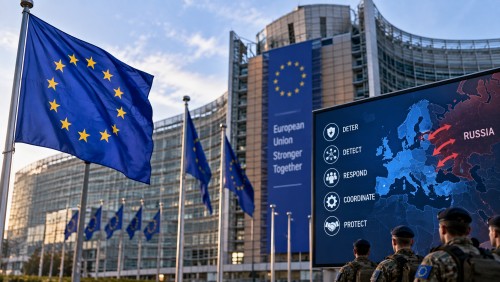
The European Union is set to enhance its security framework by developing an emergency security mechanism to counter hybrid threats. Announced by European Commission President Ursula von der Leyen during her State of the Union address, the initiative aims to address security incidents that fall below the threshold of armed aggression, mirroring NATO’s Article 4 which facilitates consultation and coordinated responses among member states.
This proposed mechanism will be a key component of a broader European security strategy to be unveiled later this year. The strategy is expected to include a counter-hybrid playbook designed to bolster the EU’s ability to manage challenges such as cyberattacks and drone incidents. Additionally, von der Leyen announced plans for a European Instrument for Strategic Enablers, aligned with NATO, to enhance capabilities in air defense, strategic transport, space, and cybersecurity.
Moreover, the EU is contemplating the establishment of a European Security Council, potentially incorporating non-EU nations like Ukraine, the United Kingdom, Norway, and Canada, to improve coordination on broader security matters across Europe. This reflects an ongoing commitment to maintain a robust security posture amid evolving threats.
While Ukraine remains a focal point in the EU’s security agenda, this address included fewer new measures specifically for the country. However, the EU plans to assist Ukraine in accessing US Patriot missiles through financial aid and providing humanitarian support for energy and heating needs. Furthermore, a defense-industry program promoting joint ventures between European and Ukrainian firms is on the horizon.
Von der Leyen also highlighted the EU’s intention to propose roadmaps for nations progressing towards membership, with Ukraine’s accession process continuing as a priority. These initiatives underscore the EU’s comprehensive approach to enhancing its security architecture and fostering stability in the region.